Showing posts with label carbon nanotubes. Show all posts

Tuesday, October 12, 2010

Boron Nitride nanotubes

I wrote about CNTs in my last post; figured it was inevitable since they get so much press.  I've been binging on Skeptics Guide to the Universe recently.  They're a weekly podcast that covers pseudoscience and various shenanigans in the world of nonsense.  Each podcast concludes with a segment known as "Science, or, Fiction", in which the SGU members guess which of the three science news stories is fiction (I should use this when I'm the tabletopics master in a Toastmasters meeting).  One podcast from earlier this year had a S or F story about boron nitride nanotubes, which I've never heard before.  I correctly guessed this is science, since I haven't yet heard a materials science article of their selection that turned out to be fiction. 


So, what the heck are boron nitride nanotubes? Well, to start, boron nitride (BN) is a binary chemical compound consisting of equal proportions of boron and nitrogen. It's the white material used in clown makeup and face powder.   It's isoelectronic (shares the number of electrons) with carbon, and can morph into similar physical structures: graphene-like, and diamond-like.  The latter  is the only material nearly as hard as diamond.  It remains a solid at temperatures up to 1000ºC for air, and up to 1800ºC in an inert gas atmosphere.  That's twice as high for carbon nanotubes. 

If you look for carbon on the periodic table, you may see boron is on its left, and nitrogen is on its right.  Carbon has four electrons in its valence shell, which means another four is needed to satisfy the octet rule.  Thus, boron has three valence electrons, and nitrogen has five.  Combining these two atoms satisfies the octet rule.  By extension, BN can form a graphene (1 atomic layer of graphite) lattice.  But what makes BN different from its carbon analogues is its wide band gap of approx. 5.5 eV, making a wide-gap semiconductor (effectively an insulator). 

The high bandgap for BN nanotubes (BNNT) is a factor behind their high thermal and chemical stability.  They also have excellent mechanical properties and high thermal conductivity, much like carbon nanotubes. 

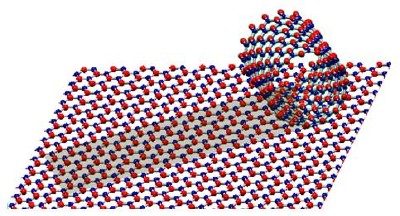
Structural models of a BN monoatomic sheet and a single-shelled BN nanotube. Alternating B and N atoms are shown in blue and red.


Boron nitrides are now being used in a rather ancient technique, the spinning of textiles into yarns.  They've already done this with CNTs as demonstrated in this video here:


Until recently, high-qualtiy BNNTs could be synthesized only up to a micron ( 1 µm) long. Longer nanotubes were riddled with crystalline defects. A team of materials scientists from four institutions
(The paper is found here) spun a ~1 mm thick yarn that looks like cotton:
This yarn is 3 cm long.  "They're big and fluffy, textile-like" said Kevin Jordan, a staff electrical engineer at Jefferson Lab.  "This means you use commercial textile manufacturing and handling techniques to blend them into things like body armor and solar cells and other applications."

How'd they spin this stuff?  By using a laser aimed at a cake of boron inside a chamber filled with nitrogen gas.  This forms a plume of boron gas that shoots upward.  They then insert a cooled metal wire into the gas, causing the gas to condense into liquid droplets.  The droplets combine with nitrogen to self-assemble into BNNTs.  It's a violent reaction that yields the long nanotubes in milliseconds. 

Mass-production of cheap BNNTs may lead to lighter, faster car frames, affordable space vehicles,  and ultralightweight armor; all promised by CNTs, but with the implication that BNNTs are simply easier to make en masse.  What separates CNTs from BNNTs in terms of utility comes down to electrical properties.  The geometry of CNTs drastically changes their conductivity. whereas BNNTs experience very little conductivity alternations with respect to geometry.  In addition, thanks to their chemical inertness, BNNTs promise "pinpoint precision to attack cancer cells by sticking to tumors, absorbing neutrons from a targeted beam, and generating local alpha radiation to kill cancer cells." (See ScienceNOW )

Sunday, September 19, 2010

CNT Loudspeakers

This seems to be something straight out of science fiction, but they've actually done it. Some smart researchers in China have figured out how to create an entire speaker out of carbon nanotubes. A piece of carbon nanotube thin film could be a practical magnet-free loudspeaker simply by applying an audio current through it. These nanotech loudspeakers (merely 10s of nm thick) can be manipulated into any shape and size while exhibiting flexibility, transparency, and stretchability. They can be mounted onto room walls, ceilings, pillars, windows, flags, and clothes without much area limitations.


In 2002, a group of Chinese researchers developed a technique for creating nanotube yarns up to 30 cm long. They drew the yarns out from super-aligned arrays of CNTs (I guess you can call this nano-knitting). Super-aligned CNT arrays differ from ordinary vertically-aligned CNTs in that their alignment is far superior to that of ordinary CNT arrays. This is important for continuous thin films, or ribbons (composed of parallel pure CNTs); in that they can can be drawn from super-aligned arrays in the solid state. These thin films are transparent and conductive, with aligned CNTs parallel to the drawing direction.

Three years later, the same group of scientists successfully synthesized super-aligned CNT arrays on 4-inch silicon wafers. One such wafer is capable of being transformed into a continuous thin film with dimensions of 10 cm wide by 60 m long (yes, sixty meters).

In 2007, Dr. KaiLi Jiang, the head of the research group and associate professor of physics at Tsingua University in Beijing, had discovered that a piece of a CNT thin film can emit sound by applying an audio frequency current through it, with the interesting of effect of the sound frequency being double the current frequency. This is attributed to the thermoacoustic effect. The alternating current periodically heated the CNT thin films, resulting in temperature oscillation. Said Dr. Jiang: "The temperature oscillation of the thin excites the pressure oscillation in the surrounding air, resulting in sound generation."

Jiang also said that the thermoacoustic effect has been studied for more than 200 years, has led to the invention of thermoacoustic engines and even loudspeaker driven refrigerators.

What remained obscure in the scientific literature is the use of alternating current in thermoacoustic generation. Jiang and his team believed they were the first to discover this effect, but they were beaten by Arnold and Crandall in the late 19th century. A & C used ultra-thin foils made of platinium to feed the current through, which then generated a very weak thermoacoustic effect; too weak for practical use. A & C claim that the sound efficiency is inversely proportional to the heat capacity per unit area (HCPUA) for the material studied. For 700 nm thick platinum foil the HCPUA value is 260 times weaker than for CNTs at the same power input.

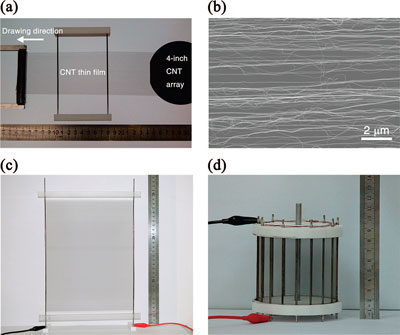
The loudspeakers were fabricated by placing the as-drawn CNT thin film on two electrodes, forming a simple loudspeaker. Several thin films were placed together so as to increase the loudspeaker area. The films could be formed into arbitrary shapes or placed on arbitrarily curved surfaces to make loudspeakers with special functions.

Carbon nanotube thin film loudspeakers. (a) The CNT thin film was pulled out from a super-aligned CNT array grown on a 4 inch silicon wafer and put on two electrodes of a frame to make a loudspeaker. (b) SEM image of the CNT thin film showing that the CNTs are aligned in the drawing direction. (c) A4 paper size CNT thin film loudspeaker. (d) The cylindrical cage shape CNT thin film loudspeaker can emit sounds to all directions, diameter 9 cm, height 8.5 cm. (Reprinted with permission from American Chemical Society). 


The CNT loudspeakers exhibit volumes and frequencies that are quite pleasing to the human ear.   When connected to a simple amplifier, the CNT thin film speaker shares all the functions of a voice-coil loudspeaker, plus the bonuses of no magnet, and no moving parts.  In contrast to conventional loudspeakers, they are stretchable, transparent, and flexible.  CNT loudspeakers also don't vibrate and are quite durable;  they can work even if part of the thin film is torn or damaged.  The possibilities are endless for CNT loudspeaker applications.  E.g., laptop computers where the current audio system is replaced by simply placing a transparent loudspeaker over the screen itself, or for tomorrow's mobile devices such as the Nokia Morph.

The team hopes to develop real commercial products with CNT loudspeakers.  This article is two years old, so progress on this front is currently unknown.  An update will appear here as soon as I hear of it.