Showing posts with label bionanotechnology. Show all posts

Friday, February 18, 2011

DNA Robospider

The nanites are here, and they're made of DNA.  Well, not really, but researchers at 4 institutions across the country have created and programmed DNA spider-bots that walk independently across a a nano-scale track.  A baby step (spider step?), but also a milestone, in the nascent fields of molecular computing and and robotics.  Eric Drexler had long envisioned molecular robots in his seminal book Engines of Creation, now manifesting into reality. 
Normally, a robot would have a set of instructions to follow specific tasks repeatedly, from vacuuming carpets to welding cars, but programming biomolecules?  Not a simple task, and requires researchers from many disciplines (CS, chemistry, engineering, biology) to collaborate, which did occur.  The result are DNA walkers with 'legs' that allow them to briefly walk autonomously on a fabricated 2D landscape.  They can begin and continue walking, turn, then stop.  Rinse and repeat.  The walkers are only ~ 4 nm in diameter, and walk very slowly, covering 100 nm in 30 minutes to an hour by only 100 steps.   Compare that to previous walkers took that long to walk only 3 nm.
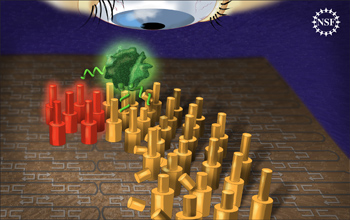
Researchers have created and observed a molecular robot capable of many steps, and of making decisions where to step and how long to stay. As the robot walks on the substrate, it changes each piece by cleaving off a part. If it touches a spot that has been cleaved already, it does not linger as long. The end of the track glows red and captures the robot, letting the researchers know when it has completed its walk. The robot glows green, allowing for the researchers to see it better. Credit: Zina Deretsky, National Science Foundation


This shows high promise for the emerging nanomedicine field, which promises localized cancer treatment.  Imagine a time when we can look back and consider chemotherapy to be barbaric and inhumane.  Nanomedicine could be our ticket to that future. 

Wednesday, December 8, 2010

Plasmonics at the bottom: Nanoshells and Invisibility Cloaks

Plasmonics may have roles to play aside from computing.  Researchers Naomi Halas and Peter Nordlander at Rice University have developed structures called nanoshells that consist of a thin layer of gold coating (usually 10 nm thick) around the entire surface of a silica particle about (100 nm in diameter).  Placing this coated particle in an electromagnetic (EM) field generates electron oscillations in the gold shell; this is due to the coupling interaction between the fields on the shell's inner and outer surfaces.  Varying the silica particle size and the gold layer thickness changes the wavelength at which the particle resonantly absorbs energy.  In short, nanoshells can be designed to selectively absorb wavelengths from the blue end of the visible spectrum (approx. 300 nm), and down to the near infrared (about 10 microns).

Surprisingly enough, nanoshells are now being considered for cancer treatment.  In 2004, Halas, working with Rice colleague Jennifer West, injected plasmonic nanoshells into the bloodstream of mice with malignant tumors and found that the particles were nontoxic.  Moreover, the nanoshells tended to embed themselves in the rodents' cancerous tissues rather than healthy ones due to higher blood circulation in the fast-growing tumors.


Additionally, human and animal tissues are transparent to radiation at certain infared wavelengths.  When near-infrared laser light is aimed at the tumors through the mice's skin, the resonant absorption of energy in the embedded nanoshells raised the temperature of the cancerous tissues from 37 ºC to 45 ºC.

This photothermal heating killed the cancer cells while leaving the surrounding healthy issue intact.  In the mice treated with nanoshells, the tumors virtually disappeared within 10 days; in the control groups, the tumors grew unabated.  As of 2009, practitioners are seeking FDA approval for clinical trials of nanoshell therapy in patients with head and neck cancer.

Plasmonics may also revolutionize the lighting industry by making LEDs bright enough to compete with incandescent bulbs.  In the early '80s, researchers found that the plasmonic enhancement of the electric field at the metal-insulator boundary could make certain dyes more luminescent if placed near the metal's surface.  This kind of plasmonic enhancement can also raise the radiation rate of quantum dots and quantum wells (tiny semiconductor structures that absorb and emit light), which improves the efficiency and brightness of solid-state LEDs.  A recent collaboration between Caltech and Nichia Corporation in Japan demonstrated that coating the surface of a gallium nitride LED with dense arrays of plasmonic nanoparticles (made of gold, silver, or aluminum) could intensify the emitted light 14-fold. 

Additionally, plasmonic nanoparticles may one day lead to LEDs made of silicon.  Silicon-based LEDs would be much cheaper than conventional LEDs composed of gallium nitride or gallium arsenide, but such devices currently emit too little light.  Research has shown that coupling silver or gold plasmonic nanostructures to silicon-dot arrays could boost their photon intensity by 10 times.  Moreover, the frequency of the enhanced emissions can be tuned by adjusting the geometries of the nanoparticles.  Simulations have indicated that careful tuning of the plasmonic resonance frequency combined with precise control of the separation between the metallic particles and the semiconductor materials may allow emission rates to rise more than 100-fold, allowing silicon LEDs to shine just as brightly as traditional devices.

Then there's the plasmonic analogue to a laser.  Mark Stockman of Georgia State University and David Bergman of Tel Aviv University theorized a new device called a SPASER (surface plasmon amplification of stimulated emission of radiation).  They have suggested fabrication methods via semiconductor quantum dots and metal particles.  The radiative energy from the quantum dots would be transformed into plasmons, which would then be amplified in a plasmonic resonator.  The plasmons generated by a SPASER  would be much more tightly localized than a conventional laser beam; this would allow the device to operate at very low power and selectively excite very small objects.  The result: SPASERs may further sensitize spectroscopy to more phenomena and to more sensitive hazardous material-detectors for minute amounts of chemicals or viruses.

Speaking of excitement, plasmonics are a potential candidate for the proverbial invisibility cloak of Hollywood films.  What is taught again and again in freshman physics is the refractive index, which is the ratio of the speed of light in a vacuum to the speed of light in the material.  If the refractive index is made equal to that of air, the object is rendered nearly invisible.  For plasmonic materials, this could be done with two things:
1) Use radiation that is close to the resonant frequency of the structure; it would neither bend nor reflect light.  The light is absorbed, never to bounce back to the observer's eye.
2) Laminate the structure with a material that produces optical gain (amplifying the transmitted signal just as the resonator in a SPASER would); the resulting higher intensity would offset the absorption losses.  The structure is thus rendered invisible, at least to radiation in a selected range of frequencies.

In theory, plasmonic materials could render objects invisible.  In one proposal, the cloaking device would be a thick shell constructed of metamaterials, which exhibit unusual optical properties.  This shell could bend radiation around its central cavity, where a spaceship could be hidden.  A space telescope pointed at the shell would see only the galaxy behind it. 
Now, it's one thing to render an object invisible for a set frequency, but it's quite another to hide it for the entire visible spectrum.  Some physicists say it is possible.  John B. Pendry of Imperial College London and colleagues showed that a shell of metamaterials might, in theory, reroute the electromagnetic waves traveling through it, diverting them around a spherical shell, as seen in the figure above.

Invisibility cloaks may never see the light of day (ha!), but such ideas highlight the wealth of optical properties that inspire scientists working in plasmonics.  By investigating the sophisticated coupling between electrons unbounded to atoms, and electromagnetic waves, researchers have identified new possibilities for transmitting data in our microchips, illuminating our homes, and fighting cancer.  Indeed, there's still a lot of 'room' to explore in plasmonics.

Monday, May 10, 2010

A cure for bee stings?

In the current issue of Chemical & Engineering News, a small article titled "Plastic Antibodies Target Peptide" explains a new method of removing bee toxins from blood. Molecularly imprinted polymeric (MIP) nanoparticles can act as "plastic antibodies" to neutralize toxins in live animals. Researchers from UC Irvine developed the MIP nanoparticles to target the peptide melitten, a component of bee venom that tears cells open such that their cell-entrails spill out. Given enough, melitten may lead to kidney failure and death.

The nanoparticles are created by polymerizing acrylamide monomers (a monomer is a molecule that has the potential to bind other molecules of the same species to form a polymer). You don't need to know about acrylamide, but in case your curiosity got the best of you, wikipedia has a good entry.

The authors began the study by injecting a lethal dose of melitten into mice. They then immediately injected the melitten-targeting MIP nanoparticles into a selected group of mice, which a control group did not receive. The MIPn mice showed a significantly higher survival rate than the control group.

Note that the MIP nanoparticles had already shown an affinity and selectivity toward melitten in vitro that is comparable to those of natural antibodies in older studies. The mice study here is the first animal study involving the MIP nanoparticles. According to Steven C. Zimmerman from UI Urbana-Champaign, this is an "excellent demonstration" of synthetic antibodies to "selectively bind peptides and related targets in the complex environment within the bloodstream."

The antibodies are also said to show minimal toxicity. The measurements were conducted via florescence-imaging of dye-labeled nanoparticles and melitten. The nanoparticles and melitten were shown to accumulate in the same cells in the liver, suggesting that the nanoparticles sequester the toxin and that the complex is then cleared from the body by the liver.

Needless to say, nanoparticles could be synthesized for a variety of targets; this may mean that the sky is the limit within this new field of research.